The fabric makes 80% of the image. The projector does the rest.
The same projector can deliver a mediocre image or a reference image depending on the fabric that receives it. Gain, uniformity, color accuracy, acoustic transparency: every LumeO fabric is chosen for a use case, not a price point.
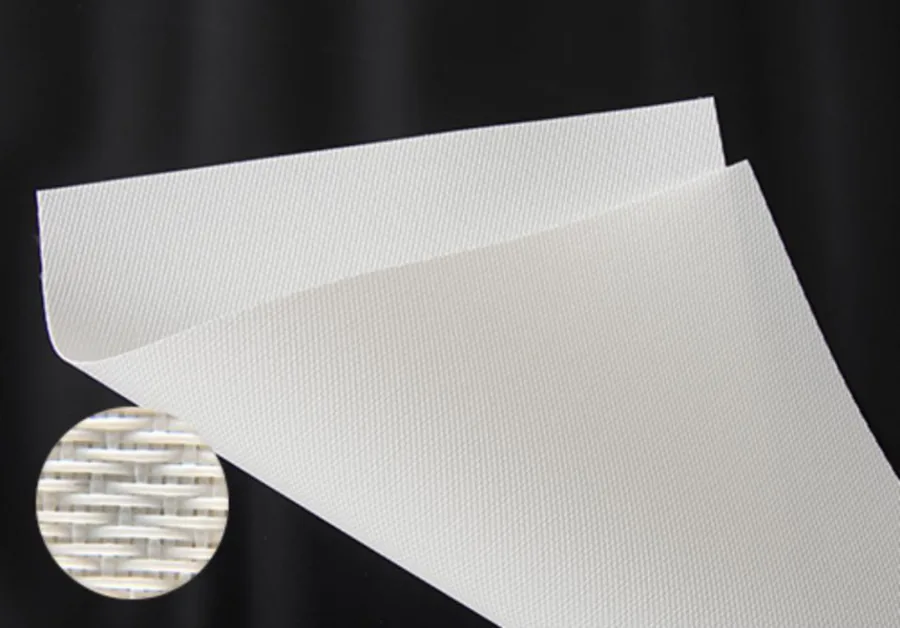
Woven acoustic Woven fiber
Gain 1.0 · 140° · 76,000 openings/ft²
A high-density woven fiber surface with more than 76,000 micro-openings per square foot. Sound passes through cleanly, and the woven structure suppresses the moiré (interference fringes) that a projector can reveal on a perforated surface. It lets you place the front speakers directly behind the image, as in a commercial cinema.
Speakers behind the screen · Cinema Sonic Edge
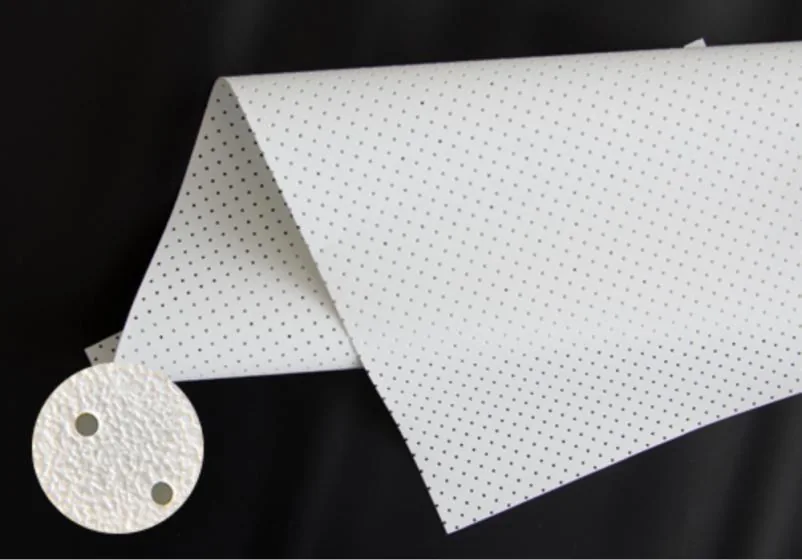
Perforated acoustic 0.4 mm perforated
Gain 1.1 · 5.77% open area · < 1 dB @1kHz
UHD micro-perforated surface (0.4 mm holes, 5.77% open area) engineered to minimize pixel loss and moiré while keeping audio attenuation under 1 dB at 1 kHz. Available in widths up to 3 m, it preserves image quality at closer viewing distances than a woven fabric would allow.
Baffle-wall L/C/R, minimal light loss · Cinema Sonic Edge
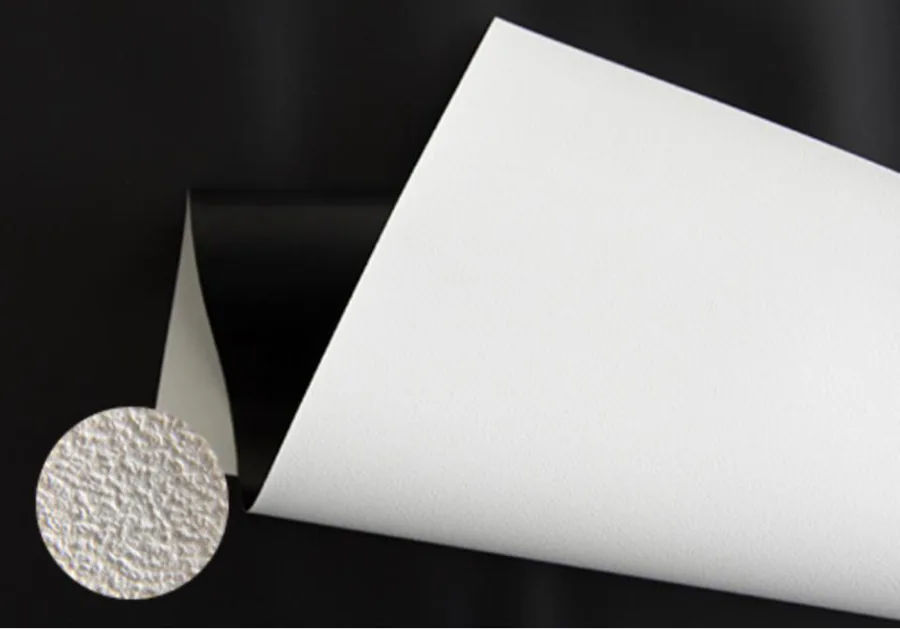
Flexible white Gain 1.0
Gain 1.0 · 160° · 0.32 mm
A flexible PVC composite surface with a fine diffusing texture that spreads incident light across a wide 160° viewing angle. Light, compact and easy to transport, it is the versatile reference for retractable and fixed-frame screens in most rooms.
Retractable & fixed frame · Cinema Nova, Edge, Lift
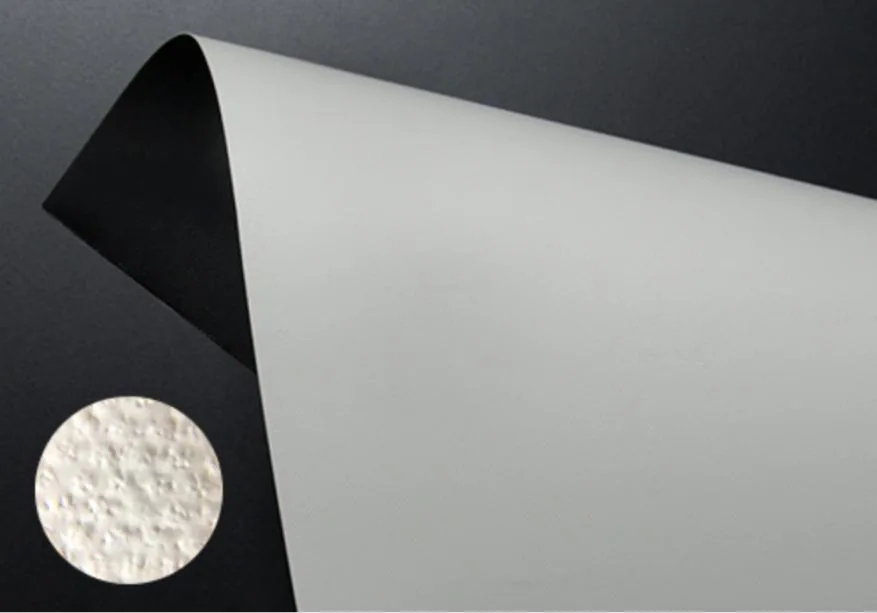
Matte white glass fiber Self-flattening
Gain 1.0 · 160° · 0.4 mm
A glass-fiber surface that stays naturally flat without tensioning, with strong weather and chemical resistance and stable behaviour across temperature swings. Its self-flattening nature makes it ideal for in-ceiling and electric screens where a taut, maintenance-free surface matters.
In-ceiling & electric screens · Cinema Vault, Nova

UST ALR lenticular 93% light rejection
Gain 0.8 · 160° · UST-optimized
A lenticular (black-grating) structure whose horizontal prisms absorb overhead and side ambient light — up to 93% rejection — while reflecting the projected light back to the viewer. Optimized for ultra-short-throw projectors, it keeps contrast and color uniform across a 160° angle, even with the lights on.
Ultra-short-throw, bright room · Cinema Lift UST
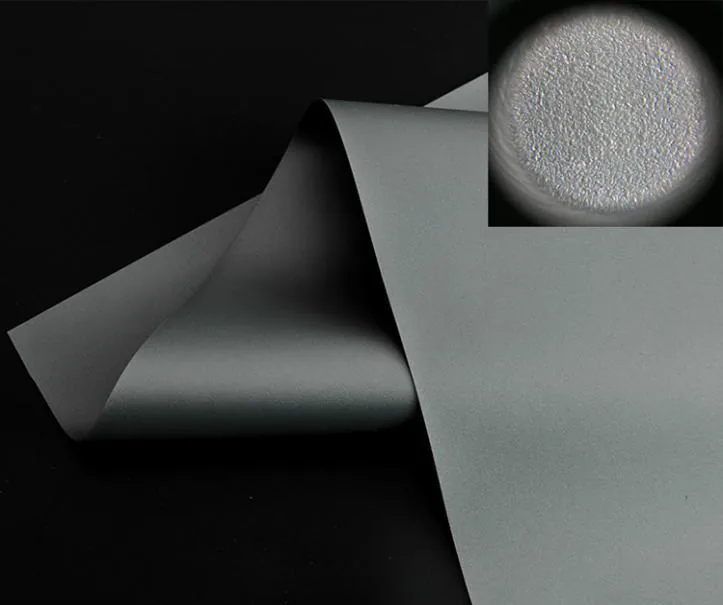
Long-throw ALR Light rejection
Gain 0.8 · 160° · 0.32 mm
An ambient-light-rejecting surface for standard long-throw projectors: it filters and absorbs stray light to preserve contrast, shading and color saturation in a partially lit living room — farewell to strict dark-room conditions — while keeping a wide viewing angle.
Bright living room, daytime viewing · Cinema Nova
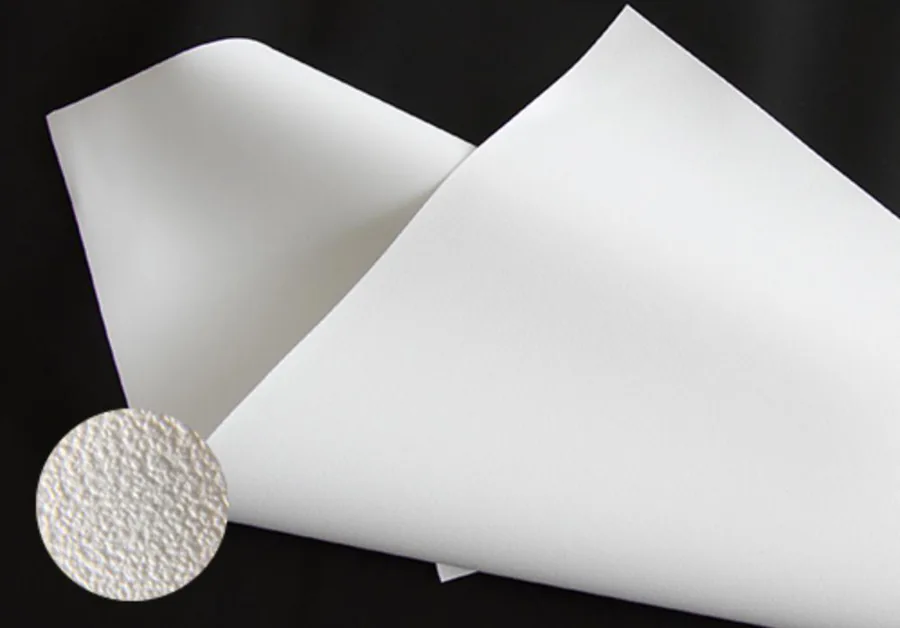
Dual-sided white 4K / 8K
Gain 1.1 · 160° · dual projection
A double-sided surface that can be projected onto from either side, for rooms that present content in two directions — conference rooms, multipurpose halls, exhibition spaces. High brightness and faithful color reproduction, ready for 4K and 8K sources.
Two-way projection, pro venues · Nova Pro