Five questions are enough to determine the right screen. We ask them in this order on every room we install: light first, size last. This guide follows that same method, without unnecessary jargon.
Step 1
How much light is in the room?
This is the criterion that rules out the most options — and the one most often overlooked. A white surface reflects the projector's light, but also the room's. In a lit living room, blacks turn grey and the image washes out. Three families of surfaces answer this problem, and they must not be confused: white is neutral and bright, but corrects nothing; grey lowers the black level by attenuating light uniformly; ALR selectively rejects the light coming from the ceiling and the sides. Grey and ALR therefore solve different problems.
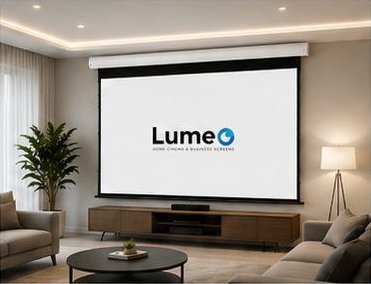
A living room in daylight: ambient light is what dictates the choice of surface.
Dedicated room, dark walls, no windows
White surface, gain 1.0: maximum contrast and a wide viewing angle. No need to pay for ALR here — it would bring nothing.
Dark room, but light-coloured walls, ceiling or floor
Grey surface (gain 0.8). The image's own light bounces off the light surfaces and comes back to wash out the blacks: a grey surface absorbs those returns and restores depth. Condition: a projector with brightness to spare, since it also dims the image.
Living room with windows, evening viewing with curtains drawn
Flexible white surface in most cases. If lamps stay on during the film, move up to a long-throw ALR.
Bright living space, daytime viewing
ALR is essential. Gain 0.8, up to 93% ambient light rejection: that is what lets you watch without closing the shutters.
Ultra-short-throw projector sitting below the screen
A UST-specific lenticular ALR. A standard ALR does not work with a projector lighting from below — the surface structure is not oriented the same way.
Step 2
Should the screen disappear?
A fixed frame delivers the best flatness and the best contrast — the surface is permanently tensioned and the velvet borders absorb spill light. But it stays visible at all times. A motorized screen lowers for viewing and disappears the rest of the time, at the cost of a case to integrate and a mechanism to maintain.
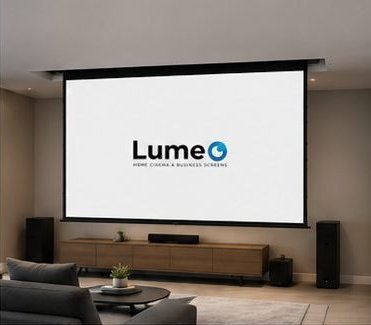
Recessed into the false ceiling: between sessions, nothing remains in sight.
Dedicated room: the screen can stay in place
Fixed frame. It is the reference for image quality, and the simplest mechanically — therefore the most durable.
Living room: the screen must vanish between sessions
Retractable motorized, with a surface-mounted case on the wall or ceiling.
False ceiling available, invisible integration
In-ceiling motorized: the case disappears into the ceiling, only the surface comes down. Must be planned during the building works.
No drilling possible (rental, showroom, event)
Floor-rising screen: the surface rises from a case standing on the floor, with no fixing at all.
Step 3
Do the speakers sit behind the screen?
In a commercial cinema, the front speakers sit behind the screen: dialogue comes from the actors' mouths, not from a point below the image. To reproduce that at home, the surface must be acoustically transparent: a high-density woven fibre, which sound passes through with less than 1 dB of attenuation at 1 kHz.
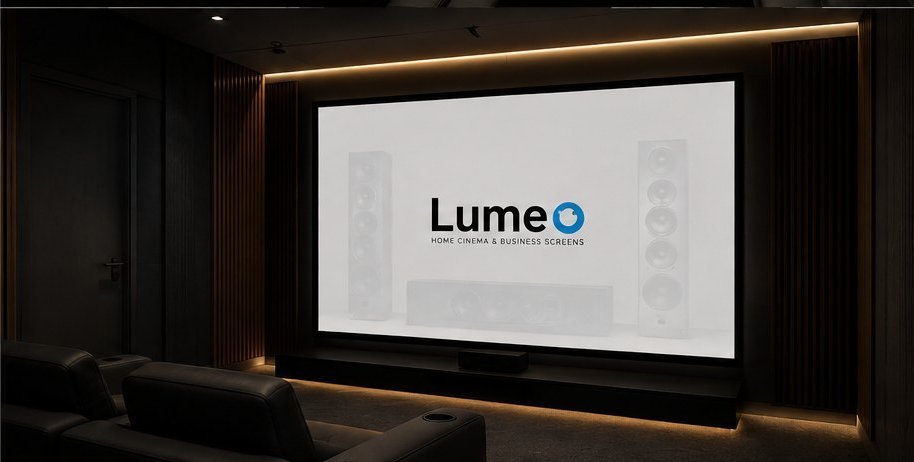
Dedicated room: the front speakers disappear behind the surface.
Left / centre / right speakers behind the surface
An acoustically transparent surface is mandatory. Plan the wall clearance and the frame accordingly from the design stage.
Speakers below or above the screen
Standard surface. No constraint, and a slightly brighter image for the same projector.
Step 4
What screen size?
The right diagonal depends on the distance between the seats and the screen — not on the projector. The SMPTE (30° viewing angle) and THX (36°) standards define the comfortable minimum, not the ideal: they are floors, not ceilings. In a dedicated room we deliberately aim at the top of the range — between 40° and 48° — because that is where immersion becomes genuinely cinematic. The figures below follow that approach: we push the size to the maximum that stays comfortable.
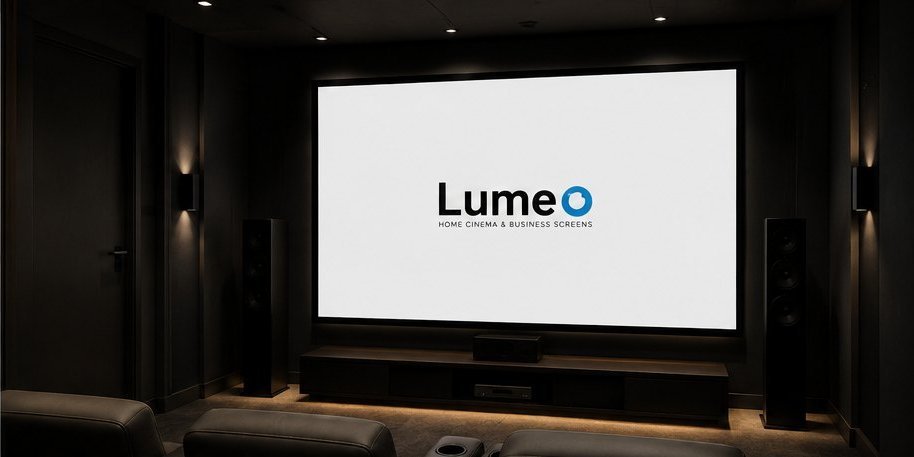
It is the distance between the seats and the screen that sets the diagonal.
Recommended diagonal by viewing distance — immersive approach, 40° to 48° viewing angle (16:9 format)
Viewing distance (seat → screen)
Recommended diagonal
Surface width
2.5 m
80 – 100″
1.77 – 2.21 m
3 m
100 – 120″
2.21 – 2.66 m
3.5 m
115 – 140″
2.55 – 3.10 m
4 m
130 – 160″
2.88 – 3.54 m
4.5 m
150 – 180″
3.32 – 3.99 m
5 m
165 – 200″
3.65 – 4.43 m
6 m
195 – 240″
4.32 – 5.32 m
So where does the projector come in?
The projector does not determine the recommended size — it only has to be able to produce it from where it sits. That is the throw ratio: throw distance ÷ surface width. A projector with a 1.5 ratio placed 4 m away produces a 2.66 m wide image. Check that figure in its datasheet before ordering, or send us the model and the room plan and we will do the calculation.
Three factors limit how far you can go. Room width first: leave at least 25 to 30 cm of wall on each side of the surface, and 60 cm if the front speakers stand on the floor. Brightness headroom next: at constant lumens, a larger surface spreads the same light over more area. Source quality last: a very large screen reveals the compression of a streaming feed. In 4K, with a recent projector and a quality source, it is almost always the room that sets the limit — not the technology.
Step 5
16:9 or 2.35:1?
16:9 covers everything: series, sport, streaming and most films. 2.35:1 (CinemaScope) matches the theatrical film format — more width, more immersion — but imposes black bars on either side for everything else, and requires a projector with zoom memory or an anamorphic lens. Choose it if you mainly watch films in a dedicated room; otherwise 16:9 remains the most versatile.
The vocabulary
The seven terms that always come up
Gain
The ratio between the light reflected by the surface and that of a reference white surface. Gain 1.0 = neutral. A high gain sends more light back along the central axis, but narrows the viewing angle: viewers to the sides see a darker image.
Grey surface (contrast enhancing)
A surface with a grey rather than white base. It attenuates light uniformly — the room's as well as the projector's — which lowers the black level and strengthens perceived contrast. It is the answer to light bouncing off pale walls or ceilings. It assumes a projector with brightness to spare.
ALR (ambient light rejection)
An optical structure that absorbs light coming from the ceiling and the sides while reflecting the projector's light back to the viewers. The essential difference with a grey surface: ALR sorts light by its angle of incidence instead of dimming everything. Only ALR makes viewing possible in a genuinely lit room.
Acoustic transparency
The surface's ability to let sound through unaltered, so the speakers can sit behind the image. LumeO uses high-density weaving: more than 76,000 micro-openings per square foot, without the moiré a perforated surface can reveal.
Tab-tensioning
A side-tensioning mechanism on motorized screens: the surface is pulled sideways by small tabs, keeping it perfectly flat. Without it, a large motorized screen ripples.
Moiré
Interference fringes appearing when the projector's pixel grid resonates with that of a perforated surface. A woven surface or a fine perforation eliminates it.
Black drop
The black band between the case and the top of the image on a motorized screen. It lets you lower the image to the right height without moving the case.
Send us the room dimensions, the projector model and the speaker positions: we will come back with the right surface and format. That is what our integrators do for a living.